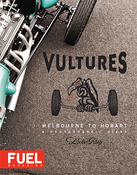


Each week we completely republish a story from a back issue of one of our publications. This week it’s Craig Metros’ A Model hot rod from issue 04 of Fuel Magazine.
Story: Craig Metros
Photography: Luke Ray
Date: Fuel Magazine Issue 04, June 2010
I can’t remember my first hot rod show because, as my dad, Gus, has explained countless times, I was still in a baby stroller. Born and raised inDetroit,Michigan, the son of a General Motors Engineer, and self-proclaimed car nut, my future was set in stone, or should I say “sheet metal” at an early age. Hot rods, muscle cars, classics, race cars, European sports cars, futuristic concept cars; anything with 4 wheels and an engine held my interest.
Since my days in a stroller, I have experienced countless car shows, events, swap meets, and races. Some of my favorites include Bonneville Speed Week, the L.A. Roadster Show, Eyes on Design, and the Bendigo swap meet. While over the past 25 years I have owned a few interesting cars including a 1956 BMW Isetta, 1972 SS Chevelle, a 1977 911 Turbo, and a 1963 Cadillac Convertible, I have never owned a hot rod. My only personal experience with a hot rod was my dad’s 1940 Ford Coupe that he owned during the ‘70s.
The Forty Coupe is such a beautiful car by design and a classic, in my humble opinion. I think it looks even better with a slight rake and the right wheel/ tire combination. My dad’s coupe was a creamy beige color, powered by a Mercury Flat Head, had that “slight rake” and sounded terrific. It was the first manual shift car I had ever driven. It also was the first car I worked on….having to help my dad replace that same manual transmission I destroyed.
My desire for an opened-wheeled, bare bones hot rod really blossomed once I moved to Melbourne 4 years ago. Even though the hot rod scene in Australia may be smaller than I’m used to, the passion, creativity, skill, craftsmanship, attention to detail, concern for safety, and sense of community far exceeds anything I have ever experienced.
The time felt right for me to make a purchase. After about a year of browsing Ebay, Hemmings, and the HAMB, a matte black ‘31 Model A coupe, sporting a mean chop and channeled original tin, powered by an AB Flat Head caught my eye. The stance and proportions combined with the rough, raw, and unfinished state of the car was exactly what I wanted. The car was located in theU.S. and built by Josh Higgins from the Amocat Speed Emporium inPuyallup,Washington State.
I wasn’t ready to build a car from scratch. The last time I had turned a spanner (wrench as it’s known back home) on a car, was the summer of 1981. I pulled out the tired 350 small block from the Chevelle in my parents’ garage and rebuilt it. That was a great learning experience. Unfortunately, that was 29 years ago. I can’t remember what I had for dinner last night. I did however, want a project to work on and learn from. I have learned to weld, bead roll, and spray paint with a proper automotive spray gun thanks to Allen, Shayne, Mike, and Nick.
Once the car arrived toMelbourne and in my hands, I immediately started making changes. I eliminated the bright red paint on the engine block along with the matching bright red and stark white pin stripping that was heavy handed and didn’t relate to the body lines. The exhaust consisted of individual 400 mm long straight pipes that were beyond loud;… I guess that’s a sign of getting older. I had them replaced with lake pipes that were fabricated by Allen Stewart. I installed a new radiator and notched out more of the lower grill shell to allow the nose to drop, achieving slightly more rake to the bonnet profile. I also replaced the original head mounted, cone top oil filter with the classic Bee Hive and relocated it to the cowl.
The interior was very raw and incomplete. The ‘36 Ford dash panel housed 2 ill-fitted aftermarket gages and more overpowering pin stripping. I found a refurbished ‘36 gauge set and chrome waterfall panel on line. Without these components, the ‘36 dash panel looked like an extruded plank. The round opening in the waterfall panel originally housed an optional radio. I used it to mount a vintage Stuart-Warner tachometer I picked up at the Bendigo swap meet. Allen fabricated the cabin and boot sub floor and built a lower profile bench seat from scratch, replacing the overstuffed, worn out Model A seat. Adrian Morgan upholstered the new seat in distressed brown leather. I wanted the cabin to look utilitarian and race car minimal as opposed to looking unfinished. Future plans for the car include replacing the steel rod roof supports with timber cross bows and fitting a vintage racing roll bar behind the seat.
As an artist, I feel as though the car is an art project on wheels. Paint brushes and spanners rest in the same pile in my art studio where the vehicle is stored. My layout table, originally covered in remnants from my wall pieces, now holds a spare fuel line, stainless steel hardware, and transmission fluid. Similar to my art, the car has been a great stress reliever and creative outlet.
Even though it has been a while since I have worked on anything that actually needs to function, it’s slowly coming back to me. I’ve made new friends and have had plenty of help, advice, and encouragement along the way from people like Allen, Shayne, Mike, Rob, Nick, Pete, and Terry. And of course, I can’t thank my friends without mentioning the guy pushing that stroller some 40 years ago. I have to say thank you to my dad, Gus, (and my mom, Beverly) for influencing and guiding me down the path I am now cruising on in a ‘31 Model A hot rod.
0